
It never ceases to amaze me the different ways in which people tell their stories. The possibilities are endless and a little bit overwhelming because there are so many options. But heres the thing, it’s your story, so just start telling it.
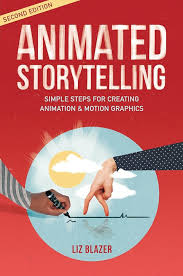
Liz Blazer writes in her book, “Animated Storytelling, Simple Steps For Creating Animation & Motion Graphics, “There are lots of reasons to love telling stories using animation. But the best reason? There are no limits. You can break rules of gravity, toss aside the space-time continuum, invent impossible worlds, and take your audience on a journey simply with shapes, sounds, and colors.”
Blazer presents ideas for a three act story in both linear and non-linear structure. Linear act one being the problem. Act two the attempt at resolution of the problem. Act three is the resolution.
Non-linear will follow a different path to address the three acts themes. “First, identify a point of departure (such as a sound, an image, or an idea) that you find so powerful that you’re inspired to build around it. It must be something so much sense to you, provides you with such a spark, that even the wildest interpretation of it would prove compelling to you,” writes Blazer.
The next chapter, “Unlocking your story,” you dive deeper into story construction. Blazer’s first suggestion is establishing clear conflict, and revealing it early. Her next part is doing away with too much of the back story and character building to get to the action of the story, if something truly needs to be ing the story it will make it in a the right spot. She then suggests spying on your character so you can reveal their secret. Finally, she points out the use of graphs for storytelling, highlighting a few famous stories we all know, just simplified in graphics.
Any study and research I’ve done into storyboarding tends to be the same, however, I finally understand storyboarding through Blazer’s writing. Without going into all the details the few ideas that resonated with me were;
- Varying your shots
- Framing using the rule of thirds
- Timing
- Developing a rhythm
I’ve been wanting to create in After Effects for a while now, and I often turn to tutorials like this to do simple, yet effective, animations and motions to graphics and texts.
With anything the more you are emerged in something the easier things become. This simple ad looks easy, but the timing and continuity that it takes for all the elements to come together and cycle through take a tremendous amount of patience.
I get lost watching people’s creative works and then trying to think about how they got the animation to bounce with such grace. The timing is fantastic and the use of animation with text drive the messaging of this ad home.
For my own creation I wanted to stay simple. Mix up some photos with some video add some sounds and movements and tell my story.
 JD Photography
Leave a comment