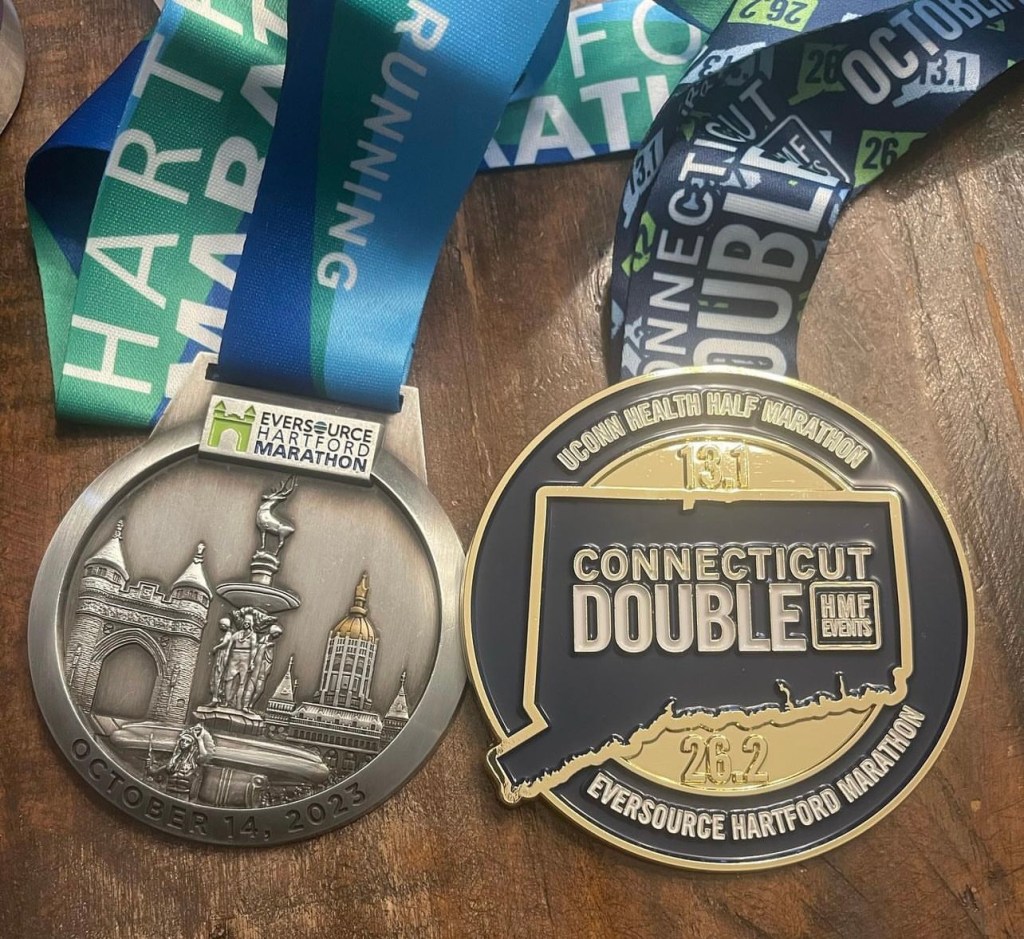
During the five hours of my first marathon I was thinking about how I was going to make Facebook posts to tell friends and family about my achievement. Completing this run earned me an extra medal, the Connecticut Double, a half marathon in the summer and a full in the fall.
I was going to post a picture of me crossing the finish line with the time clock above my head as my first post. Then I would follow up with all my medals side-by-side, and then me wearing my medals. Those last posts with the medals never came to be because my account got hacked.
People I met long ago were contacting me asking how I was successful at crypto currency, I was not in anything crypto. People also called to check on me to make sure I was ok because my Facebook looked off.
Here’s the eye opening part of my story. I made a half-hearted attempt to try and reclaim my account but deep down I knew I would be better off staying locked out. There was sadness that I would lose old pictures from a lifetime ago, old Navy pictures, undergraduate days, and various memories along the way. Gone.
Countless times a day I would click the app icon to start scrolling. I would remember I was out. Days turned to weeks, weeks turned to months. It got better. But slowly. I wouldn’t classify myself as having an addictive personality, but this is the closest I’ve felt to what being powerless over something feels like.
Addictioncenter.com writes on their site, “Due to the effect that it has on the brain, social media is addictive both physically and psychologically. According to a new study by Harvard University, self-disclosure on social networking sites lights up the same part of the brain that also ignites when taking an addictive substance. The reward area in the brain and its chemical messenger pathways affect decisions and sensations. When someone experiences something rewarding or uses an addictive substance, neurons in the principal dopamine-producing areas in the brain are activated and dopamine levels rise. Therefore, the brain receives a “reward” and associates the drug or activity with positive reinforcement.”
Was it the likes, the birthday wishes, or just a feeling of connection?
I’m reading Stolen Focus Why You Can’t Pay Attention – and How to Think Deeply Again by Johann Hari. In the first chapter Hari writes, “Shortly before I met with him, Sune had seen a photograph of Mark Zuckerberg, the founder of Facebook, standing in front of a room of people who were all wearing virtual reality headsets. He was the only person standing in actual reality, looking at them, smiling, pacing proudly around. When he saw it, Sune said, ‘I was like – holy shit, this is a metaphor for the future.’ If we don’t change course, he fears we are headed toward a world where ‘there’s going to be an upper class of people that are very aware’ of the risks to their attention and find ways to live within their limits, and then there will be the rest of society with ‘fewer resources to resist the manipulation, and they’re going to be living more and more inside their computers, being manipulated more and more.’”
I’m a child of the 80’s where technology for me was a sci-fi movie. I played outside with neighborhood kids most days, or I was out riding my bike, I didn’t have technology dependance.. I always told myself I can quite, like any addict would say. I’m only on social media for work, again like an addict would say.
I make excuses like and addict. I rationalize like an addict. Here’s the hard part, I must be an addict.
I’m free from my Facebook addiction. I no long open the app out of habit. I don’t even think about it anymore. This isn’t a happy ending, because I started X.
 JD Photography
Leave a comment